
Let Me Distance Myself
On criticism, belonging, and the comfort of being applauded by people who don’t really like you.

I don’t know if you’ve come across this online. But one of the most fascinating phenomena on social media is watching people begin a sentence with: “As a Jew…” Usually, right before explaining why other Jews are the problem. Or Zionism.
As I wrote in my previous post, Zionism is an important part of the identity of many Jews. But not all Jews see it that way. Some are just… Jewish. Like someone being Mexican, Latino, or Irish. This is part of their background, and not their identity. Sometimes, it is just a last name that gets mispronounced at airports.
Some are connected to extremist Jewish factions. And some of those factions are so extreme that they are capable of declaring anyone who thinks differently a heretic.
And for them, somewhere inside all of this, a strange dichotomy begins to emerge:
the “bad Jews”, those who are too nationalistic, too Jewish, too Israeli -
versus the “good Jews”- eager to explain that they are different. More enlightened. Less… Jewish in a traditional way.
Academia, by the way, has already prepared a name for them: auto-anti-Semites. So let’s go with it, because why not? If there’s a term, let’s use it. But wait, before we rush ahead, we need to stop.
Because this is exactly where the big confusion begins: Between legitimate criticism and discourse that creates hatred.
In my opinion, it’s allowed to criticize. It’s mandatory to criticize. I’m Israeli, after all, and I’m capable of dismantling our state, government, army, and television before my first cup of coffee. Self-criticism is not just part of our culture; it is our culture.
So where does the line cross?
It crosses between two simple questions:
Who is your target audience, and what is your goal.
And from that crossing comes the question that no one likes to ask out loud:
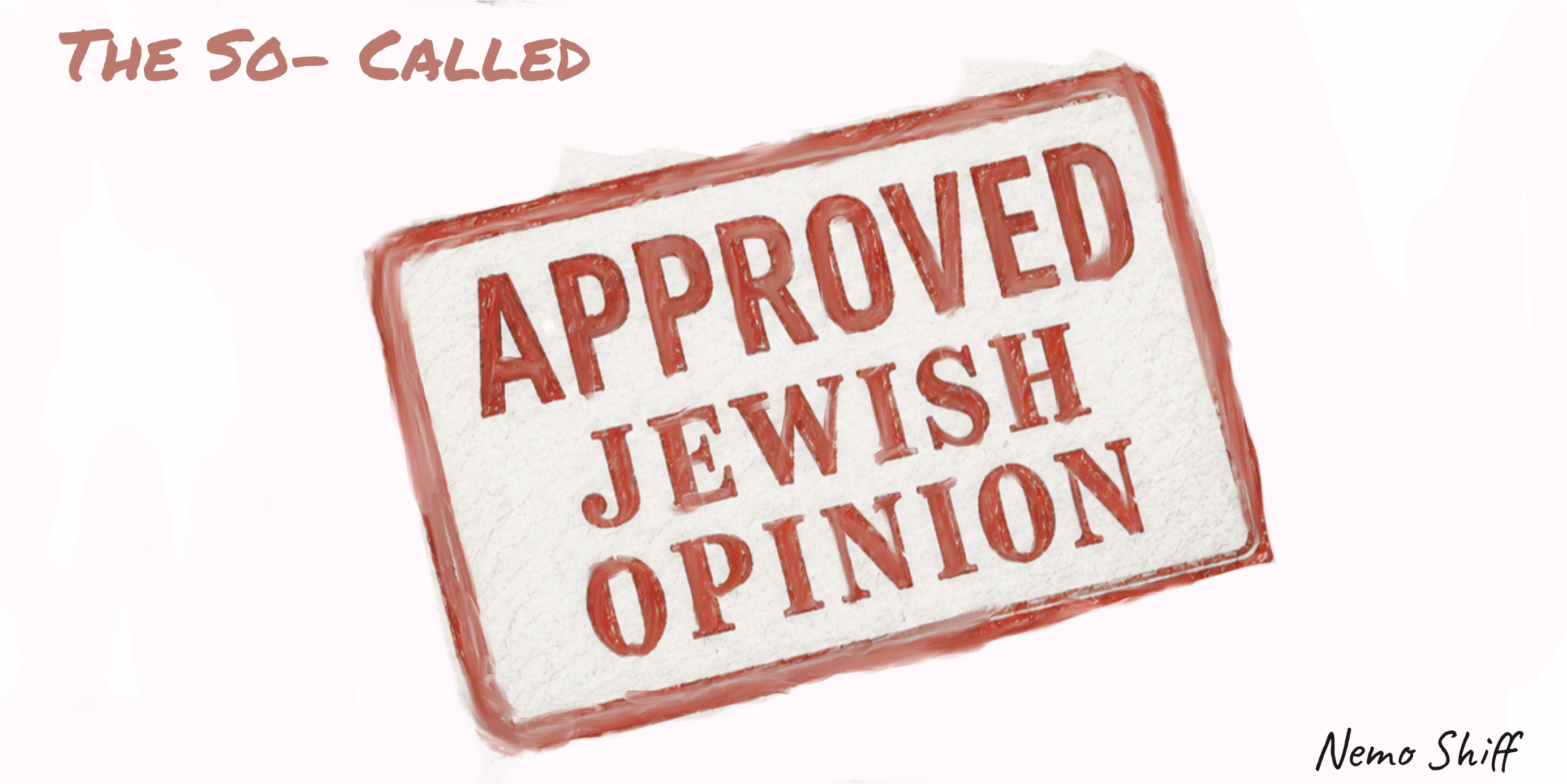
Is all of this actually an attempt to get into a club that doesn’t really want us in? A kind of desperate pursuit of “being one of the cool kids,” one that is willing to pay any price, including giving up entire parts of one’s heritage, just so someone can say: “Oh, you’re not like them, we accept you.”
And it’s not new. Absolutely not.
Auto-anti-Semitism, that ancient phenomenon of Jews developing an aversion to their own people, has existed long before the word “new anti-Semitism” was invented. It is old, flexible, and adapts to any era like an app update.
But today, unlike in the past, it has a new and brilliant core:
Fear. Fear of identifying with Israelis. With those who are accused of every possible negative title: “oppressors,” “imperialists,” “colonialists,” “baby killers.”
Pick a negative word; I know it’s on that list.
And with this view, it’s easy to understand how some Jews in the Diaspora feel they’re facing a social entrance test: “Can you shake off your group enough for us to accept you?”

And like any modern social phenomenon, this new auto-anti-Semitism did not emerge from thin air. It is well-nourished, like a houseplant that gets too much water - by the media, the politicians, the organizers of demonstrations, and the professional orators who dictate the tone. Those who determine who are the “good guys,” who are the “bad guys,” and who should be ashamed of their very existence.
For them, Israel is not just a “problematic country,” not a “complex society,” but the main villain in their imaginative movie. And when you paint a group as an absolute villain, it is very easy to dehumanize.
It is even easier to join the people who commit violence against Israelis and Jews around the world, because if you have already turned them into a caricature, what is left to feel?
And yes, in all of this, there are Israelis as well. Yes, Israelis. Most of them act out of political interest, some out of a desire to appear “brave,” and some simply enjoy the attention. And as always, anyone who speaks out against their group receives a warm embrace from the international media and anti-Israel extremist organizations. They serve as a seal of approval for them: “Here, even they say it.” And in this way, without intending to, they strengthen the narrative directed against them and their people.
And this is interesting, because in the past, in the classic anti-Semitic view, Jews who renounced their identity were not respected. They were seen as weak, spineless, traitors. They were not given a place of honor, but they did give anti-Semites a sense of approval: “Here, even they admit that something is wrong with them.”
They were useful. What they provided was not legitimacy for themselves, but legitimacy for antisemitic worldviews about Jews as a group. Since then, the packaging has changed a little. The mechanisms… not so much.
And in the digital age, where every opinion becomes a post, and every post becomes an ideology, anti-Semitic and anti-Israeli organizations have found themselves a new and convenient tool: the auto-anti-Semitic voices.
And it’s not out of love - it’s a “give and take” relationship. As long as they deliver the goods, make a mess of the house, and explain why “other Jews” are the problem, they are loved. But the moment they dare to express even a small reservation, even a thin hint of affinity for Israel, the digital gallows is immediately activated.
And maybe, just maybe, some of those anti-Israel Jews really believe that if they distance themselves far enough from Israel, the hostility toward them will disappear, too. I wish it worked that way. But history, as always, insists on being much less sympathetic.
They don’t understand that there is a difference between condemning the killing of Palestinian children, a legitimate moral criticism, and accusing every Israeli or every Zionist of genocide. And when you blur this distinction, without noticing, you create an indirect, and sometimes direct, justification for violence against the Jewish people, in Israel and around the world. And this leads to an inevitable conclusion.
This is no longer criticism. This is dehumanization disguised as morality. Because legitimate criticism comes from pain, from caring, from the desire to improve. Auto-anti-Semitism comes from the obsessive need to disavow, just so that some strangers applaud you.
The first wants to fix the wall. The second burns down the house just to prove that they know how to hold a match.

And here, allow me to mention one small detail that many of these people prefer to ignore. When Hamas members roamed the kibbutzim on October 7, they did not shout “Death to Israel” or “End the occupation.” They shouted “Itbakh al-Yahud” (“Slaughter the Jews.”) an explicit call to harm Jews as a group. Not Israelis. Not Zionists. Jews.
And here, in my opinion, like other Israel-haters, those extremists also suffer from selective blindness.
Blindness to the implications of their words for Jewish communities around the world. Blindness to the complexity of the Israeli-Palestinian conflict, which should not be reduced to slogans. Blindness to Palestinian voices that present a far more complicated reality, voices that are critical, nuanced, and sometimes completely contradict the narrative they have already chosen to adopt.
And in the end, there is no great difference between them and those they have chosen to side with. Both sides use the same dangerous simplification, the same skipping over facts, the same self-confidence that comes without responsibility. Both see only what is convenient to see and ignore anything that interferes with the story they want to tell.
I often think about why they take such an “inclusive” stance, one that can easily become discriminatory in its own way. And honestly, I think it always comes back to the same things: the fear of being different, and the desire to belong to the “right side” - the side that they see as moral, trendy, enlightened, and socially safe.
It is just unfortunate that this side includes people who are not exactly thrilled by my existence. Or by the existence of my family and friends. Or anyone who falls under the category of “Jew” or “Zionist.”
And I want to add one more thing.
What many auto-antisemites throughout history failed to understand is that, beyond being a religion or a culture, Jewishness is also an identity. Not an identity you consciously chose. But an identity that other people assign to you, sometimes even in moments when you are barely aware of it yourself. An identity imposed from the outside,
One that you can’t get rid of, no matter how much you try to shake it off. Because no matter what your political opinion is, or what you say out loud, what ultimately matters is how your environment chooses to perceive you. And if that environment is antisemitic, no statement, no post, and no public attempt to distance yourself will truly help.
Eventually, they will still see you as a Jew. Or a Zionist. Or simply “other.” And the treatment will follow accordingly. You cannot escape these perceptions. It is not a coat that can be taken off; it is more like skin.
So do not be blind.
Do not sit quietly in the face of hatred and prejudice, not in the name of “enlightenment,” not in the name of “belonging,” and not in the name of wanting to stand with the side that applauds the loudest. Because if history has taught us anything, it is that silence in the face of hatred has never truly protected anyone.
Nemo
If someone uses as a Jew in anything I start walking away since they're usually as Jewish as a ham sandwich.. but that's just my common sense kicking in cause if I stick around I may be getting jail time 😂
Excellent article Nemo. Excellent.