
RE-Packaging Hate for 2026
How modern platforms gave ancient hatred a glossy new design.

The world is changing, and you and I know that it’s not exactly heading towards a “lavender-scented utopia.” Some would say that the changes began long ago, way before we even had time to understand what was happening. They’re probably right. But don’t worry, today we won’t argue about where it started. This isn’t a history lesson, and I’m not going to ask you to open a book.
Because this time, our discussion is about something else. It’s about the sharp rise in antisemitic incidents around the world. And the horrific fact that, for some people, this now feels completely normal. As if it were a rainstorm in mid-November and not harassment, vandalism, arson of community buildings, physical assaults, and even deadly attacks against Jews and Jewish institutions.
And personally, I don’t think this is something societies should “learn to live with.” Because we are talking about human beings here, not a new Netflix category: “Hate Crimes — Suitable for All Audiences.”
Part of this problem comes from the way many countries continue treating these incidents as if they were ordinary criminal offenses, while the real issue stands directly in front of them, waving both hands in the air. And so, quietly, slowly, and without too much drama, a process of normalization begins.
The normalization of something that should never become normal. Not even for a second.
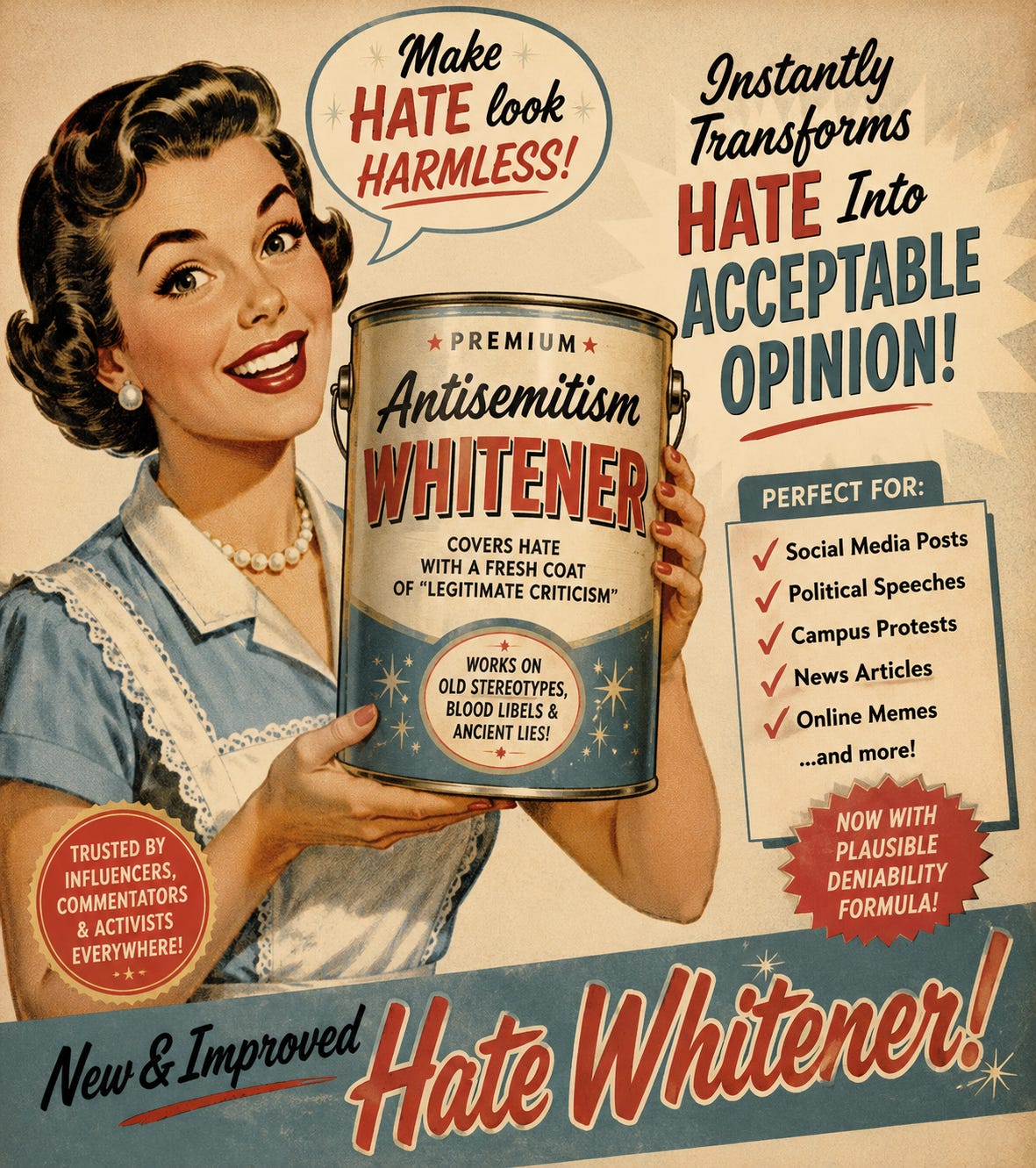
And now, let’s talk about 2026, the year in which large parts of the younger generation adopted classic antisemitic tropes. The year anti-Semitism is repackaged and presented as “critical thinking about power centers.” Yes, just like taking an expired product, putting a new sticker on it, and selling it as a “limited edition.”
And so, people who don’t see themselves as racists, because who sees themselves that way anyway, embrace it without blinking. After all, if it comes with an aesthetic filter and a hashtag that talks about social justice, then it must be okay. Right?
And this is where things become truly interesting:
When definitions themselves start changing. Because once hatred receives a modern redesign, some people stop seeing it as hatred. They start seeing it as “discourse.” Or “activism.” Or “critical thinking.” And once that happens, fighting lies becomes significantly harder, because society has already updated the terminology.
And of course… how is it possible without social media? They are not just part of the story; they are the stage, the lighting, the sound system, and the audience clapping. They make the fight against this phenomenon extremely difficult, almost impossible. And contrary to what many people still prefer to believe, this is no longer a local phenomenon.
The anti-Semitism of 2026 has long ceased to be a local problem. It crosses borders, languages, and cultures at the speed of a viral video. Because that’s what happens when the internet is essentially a global highway with no traffic lights, no brakes, and an algorithm screaming: “MORE ENGAGEMENT!!.”
And when information travels faster than human experience, perception quickly replaces reality. That creates a strange situation: millions of people now form opinions about Jews and Israelis without ever meeting either in real life. To them, we are almost mythological creatures, something between an urban legend and a conspiracy theory with subtitles.
And when a group is perceived as something distant, abstract, unfamiliar - any story can be marketed about them. Any narrative. Any plot.
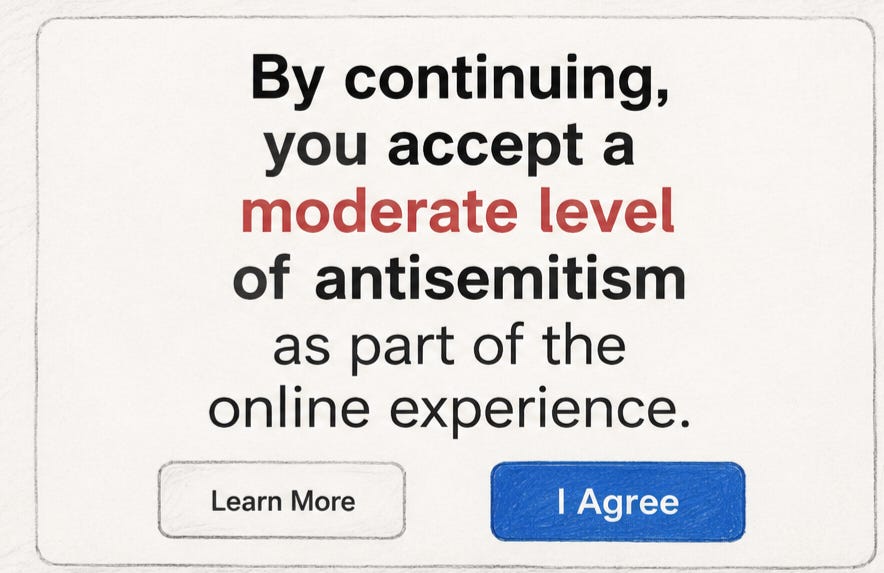
And who helps spread all this?
That’s right. The same social networks. The same platforms that manage to turn any idea, even if it’s dangerous, false, or just plain stupid, into a global trend with background music.
In practice, social media platforms have become the primary source of information for millions of people, gradually replacing much of what we once referred to as “journalism.” More importantly, it increasingly shapes how people understand reality, form opinions, build their worldview, and decide who is “good” and who is “evil.”
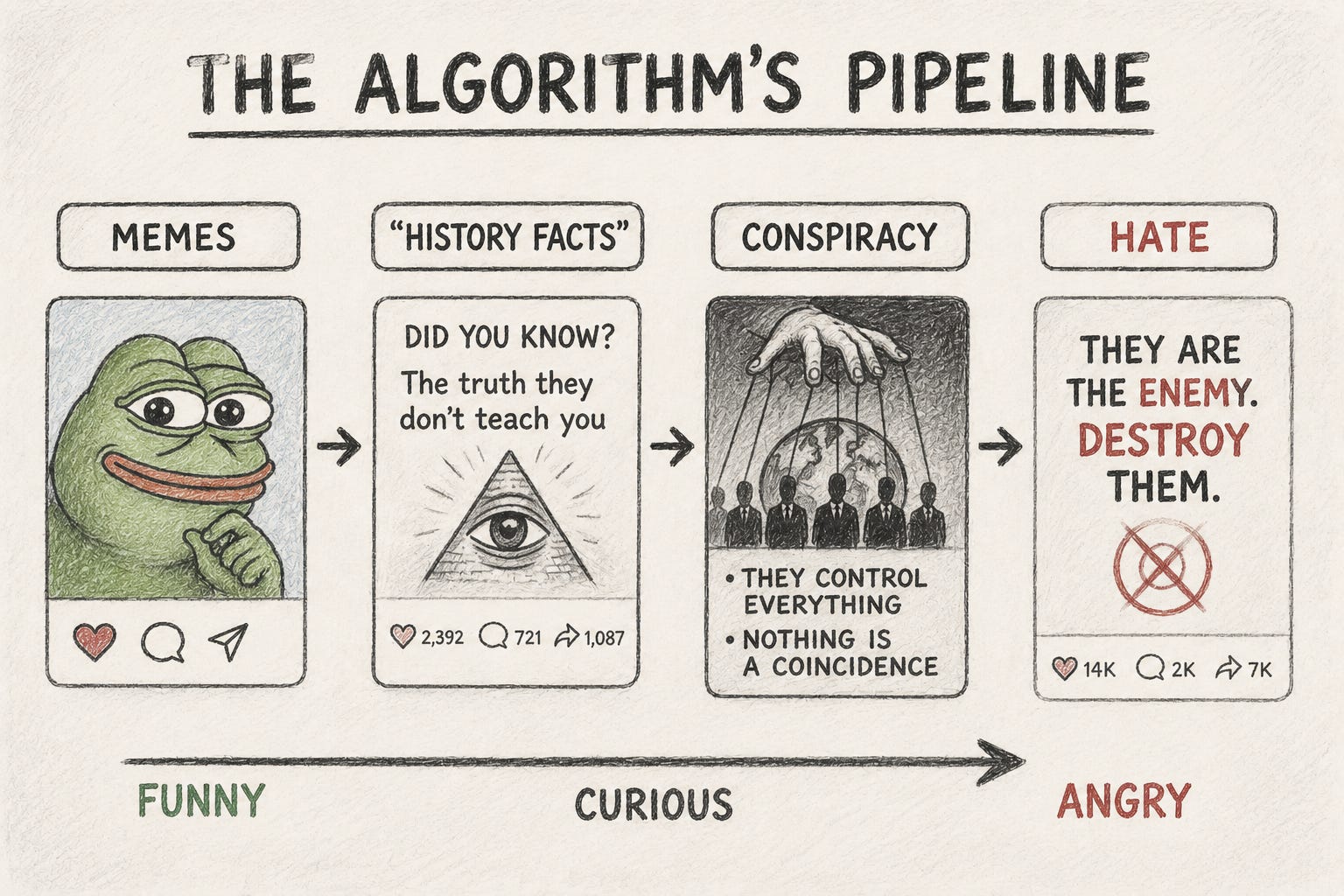
And unlike journalists, historians, or teachers, algorithms are not interested in truth. They look for one thing: screen time. And when that’s the only metric, content that generates anger, polarization, and conspiracies, three ingredients at the heart of anti-Semitism, gets a crazy organic boost.
Not because it’s true, but because it makes people stay a moment longer, respond, share, and get annoyed. The algorithm doesn’t differentiate between “this is dangerous” and “this is viral.” For it, it’s the same thing.
And so, without anyone officially planning it, social media networks are now reintroducing antisemitic imagery and narratives that once appeared regularly in European propaganda during the 1930s. Yes, the same stereotypes, the same blood plots, only with a modern filter and a small marketing trick: replacing the word “Jews” with “Zionists”.
And if you thought this phenomenon exists only inside TikTok videos, Instagram slides, and comment sections… well. Don’t worry.
The older generations still receive their version, too. For them, there are newspaper columns, political cartoons, television panels, opinion pieces, podcasts, and public figures who know exactly how to translate hatred into respectable language. And sometimes, not even respectable language.
Yes, some even make explicit calls to harm Jews, as if it were a casual remark and not dangerous incitement. Everything is wrapped in whitewashed formulations, but the content? Sharp, clear, and disturbing.
And so, while the young receive their hatred through algorithms, the old receive it through the guise of “legitimate opinion.”
But if you think all of this is transparent, clear, or straightforward, then no. Absolutely not. Because in 2026, hatred rarely arrives wearing a giant flashing sign that says: “Hello, I am propaganda.” And modern technology made that camouflage significantly easier.
Thanks to the meteoric rise of AI-based image, video, and audio creation tools, we find ourselves inundated with a new wave of anti-Semitic content created at the click of a button. And this is no longer an amateur drawing in a local newspaper.
This is sharp visuals, compelling audio, fabricated narratives that sound like an investigation, all combined with excerpts from real events. The result? A mixture that feels more believable than reality itself. Like a docu-fake film that someone decided to release without credits.
And it works. It’s appealing. And the most disturbing part? Some of this content is specifically aimed at children. Yes, children. Because why not start incitement from a young age, when everything is still perceived as “Innocent content”?
And so, while adults get their version through articles and cartoons, kids get a much more sophisticated version wrapped in technology, enhanced with effects, and presented in a way that feels like educational content.
And then comes the obvious question: “How does all of this spread so quickly in the first place?”
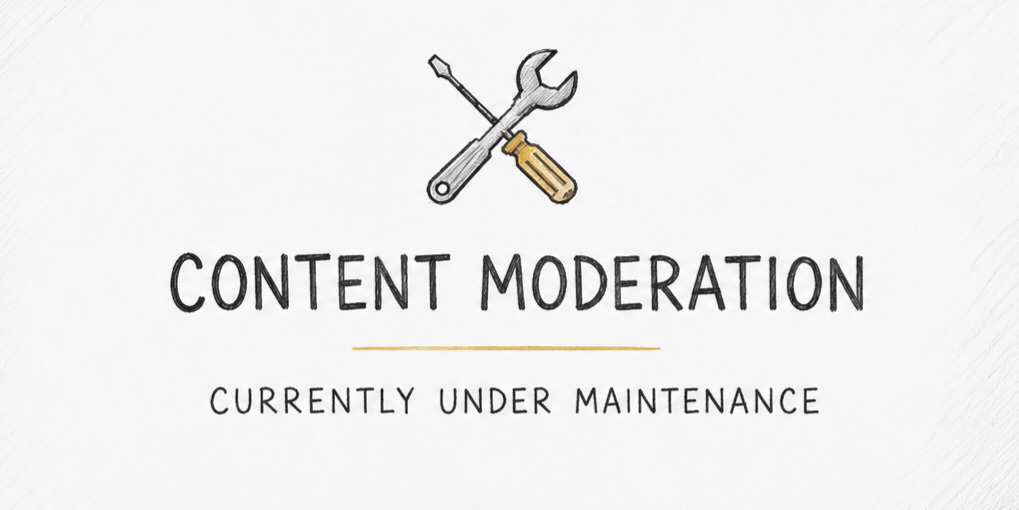
The answer, unfortunately, is all too simple: weak moderation.
Thanks to inconsistent enforcement and increasingly loose oversight from some of the companies behind major social media platforms, accounts associated with white supremacy, neo-Nazi movements, extremist, and even open supporters of terrorism now operate far more freely than they did in the past.
And when there is leeway, there is also “creativity”: selling products with Nazi or terrorist symbols, or just offensive slogans disguised as “collectibles.”
And when there is enforcement, the spreaders of hate have learned to evade it like digital ninjas. Because while the platforms’ mechanisms look for hate Speech, those spreaders of hate switched to another language, a language whose sole purpose is to fool the algorithm.
They use washed-up words, emojis with hidden meanings (watermelon, glass of water, and other symbols that have become like codes), or word distortions like “J3ws”. And so, through what is called Algorithmic Evasion, they bypass the automatic filtering mechanisms as if it were a computer game.
And this is exactly the point where the discussion stops being only about Jews. Because once a society builds systems capable of normalizing hatred against one group, those same systems can eventually be turned against almost any other group as well.
So this is the real point: The war on anti-Semitic content is not a war over “opinions.” It is not an ideological debate between two sides. It is a battle over whether societies still want to preserve a reality in which different people can continue living together at all. Because once anti-Semitism is normalized, any other form of hatred and violence can be normalized. And historically, it never ends with just one group.
And so our attitude must change. There is no escape from applying a uniform law to hate crimes, no matter who the victim is, and demanding real accountability for every case of neglect, for every incendiary content that remains on the air, for every violence that goes unaddressed.
And this is not a matter of politics. It is a matter of social survival. Because normalizing violence, of any kind, undermines the foundations of a free society. And when the foundations are shaken, the entire structure can crash. And if we don’t stop it in time, there won’t be much left to protect.
Nemo
Support my art, satire, and commentary — before the algorithm replaces everything with reaction emojis. — KO-FI
Nemo, this is brilliant and incredibly sharp. By treating this surge not as a sudden lapse in history, but as a deliberate branding and marketing phenomenon, you’ve hit on exactly why it’s so contagious right now.
Stripping away the old imagery and repackaging old poison under the sleek, comforting guise of social justice infographics and TikTok aesthetics is precisely how they’ve normalized the abnormal to a younger audience. Your point about the creeping apathy—treating targeted attacks like an inevitable November rainstorm—is brutal but entirely true.
Brilliant semiotic analysis of a dark reality. Keep pushing this out there. It’s exactly the kind of unvarnished, clear-eyed writing people need to be reading.
You nailed it, Nemo. The disinformation and conspiracy theories are marinated in enough raw emotion that actual critical thinking is incapacitated. The true enemies (terrorists) appear as benign actors and their PR campaign had a substantial head start. By the time a lie is uncovered and corrected (always in the tiniest font), the damage is done,
Superman is not coming to rescue us.
And for the first time in 71 years, I’m afraid.